Competitors
Competitors describe Plains GP Holdings, L.P.'s market in their own filings and calls. These verified passages and visual pages show where their strategies meet, using source documents preserved in Sources.
ONEOK, Inc. (OKE)
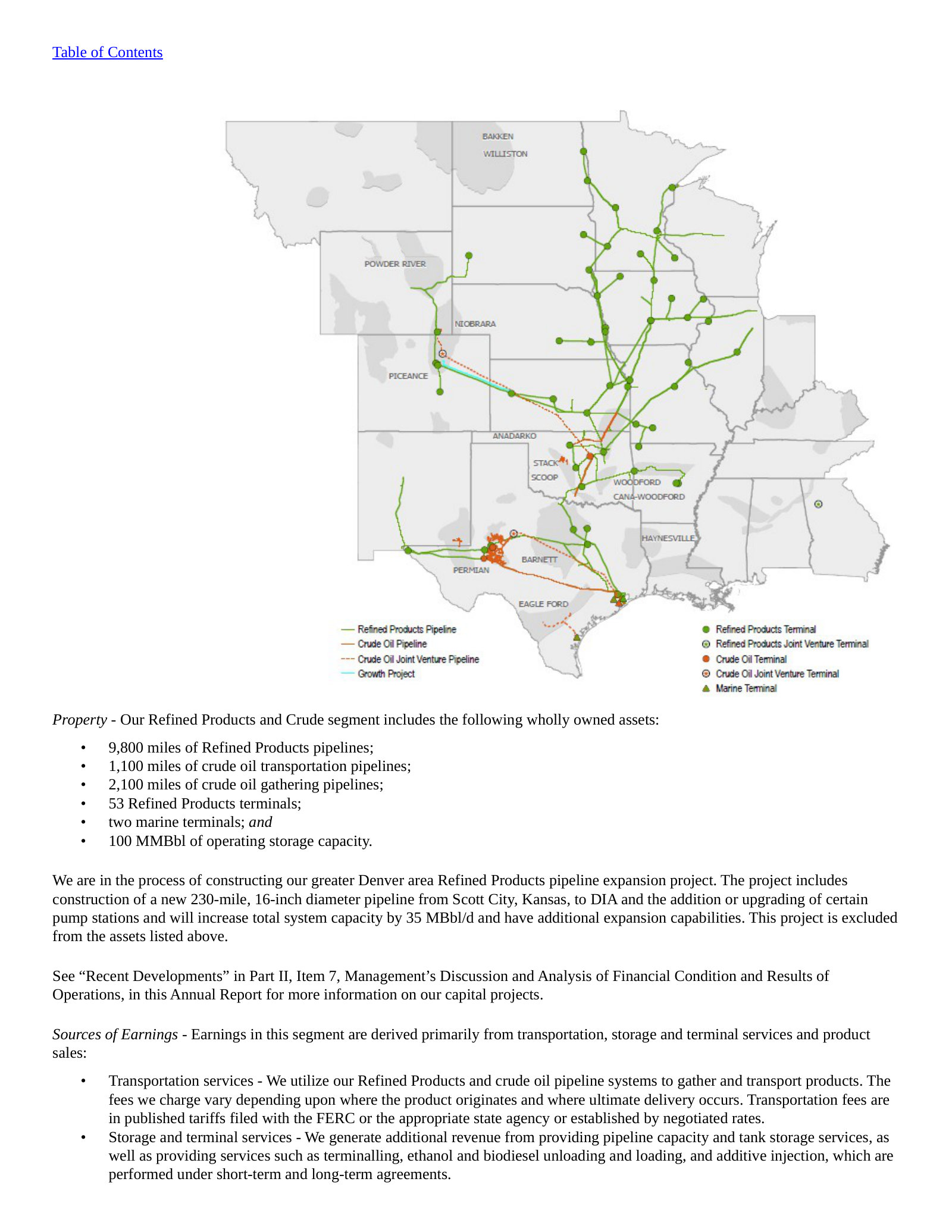
The peer whose crude business collides with Plains most specifically rather than most broadly. After the Magellan, EnLink and Medallion acquisitions ONEOK reports roughly 2,100 miles of crude gathering pipeline in the Permian and Mid-Continent, 1,100 miles of crude transportation pipeline running from the Permian to its East Houston terminal, terminals at Cushing and Corpus Christi and 100 MMBbl of storage — the same wellhead-to-hub chain PAA runs. It is also PAA's counterparty in a jointly governed asset: in July 2025 ONEOK took its BridgeTex interest from 30% to 60%, and PAA's FY2025 Form 10-K lists BridgeTex as a 40%-owned crude oil pipeline joint venture. Exhibits are confined to the Refined Products and Crude segment; ONEOK's natural gas gathering and processing, NGL and natural gas pipeline commentary is out of scope for a crude pure-play reader.
ONEOK's CFO explaining, on the FY2025 second-quarter call, why it doubled its stake in a pipeline Plains part-owns. BridgeTex moves Permian crude to the Houston area; ONEOK went from 30% to 60% and PAA's FY2025 Form 10-K still lists a 40% interest, so the two are now the only partners. Three things are the company's own characterisation rather than measured facts: that the purchase was "opportunistic," that the multiple was attractive "compared to recent transactions in the marketplace" (no multiple or comparable set is given), and that Medallion connectivity justified paying more. ONEOK's Form 10-K puts the cash consideration at approximately $270 million for the additional 30%; a straight grossing-up of that price is a crude read on what the whole entity was worth in mid-2025, and it is not a valuation ONEOK itself asserts. The last sentence is the part that matters structurally for a Plains holder: despite owning 60%, ONEOK says it will not consolidate BridgeTex because the governance arrangement with its remaining partner stays "more of a 50-50 type of governance."
Jeremy Bryan Tonet (Analyst, JPMorgan) and Walter S. Hulse (Chief Financial Officer, Treasurer and Executive Vice President, Investor Relations and Corporate Development, ONEOK): And then just want to pivot towards BridgeTex here. I was wondering if you could provide a bit more color on economics there and synergies as well. And will you be consolidating BridgeTex? […] Well, Jeremy, we were opportunistic here. We had the opportunity to increase our holdings from 30% up to 60% at very attractive multiples compared to recent transactions in the marketplace. Given the connectivity to our Medallion assets, we really thought that it made a lot of sense to continue to get more of that business. No, we will not be consolidating it going forward because we still have a governance structure with our other partner there that keeps it more of a 50-50 type of governance.
p. 6 · Read in context →
The mechanism behind the stake increase, stated plainly by ONEOK's chief commercial officer on the same call. Having gone to 60% of BridgeTex, ONEOK says it is now more economic to route barrels off its own Permian gathering system onto that line "as opposed to sending it through other pipelines," and to capture the downstream value at its East Houston distribution centre. Read as a description of intent rather than a disclosed volume shift: no barrel counts, tariffs or contract terms are given, and gathering-system barrels are frequently subject to existing dedications. It is nonetheless the clearest public statement in this peer set of the dynamic PAA names in its own risk factors — an integrated competitor using ownership of gathering to direct uncommitted barrels away from competing long-haul lines, in a basin PAA describes as already carrying multiple pipeline expansions.
Michael Jacob Blum (Analyst, Wells Fargo) and Sheridan C. Swords (Executive Vice President and Chief Commercial Officer, ONEOK): Just wanted to ask another question on BridgeTex. Just wondering if you can discuss the performance of BridgeTex this quarter. And then obviously, you've increased your position there. So I want to get your view of the outlook for that pipeline over the next couple of years. […] We are observing an increase in volume as we move forward. This pipeline connects directly to our East Houston facility, which also supplies our downstream assets. We continue to see growth in crude oil volume from the Permian, which we believe will lead to increased volume through our system. With our larger share, it becomes more beneficial for us to direct the volume from our field gathering to this system, as opposed to sending it through other pipelines. We decided to increase our stake because we are optimistic about the future. The integration of our assets with the Magellan and EnLink crude systems allows us to utilize our preferred pipelines, enhancing our value capture. This not only helps us transport more oil through our pipeline but also supports our East Houston distribution center, providing us with additional downstream value.
p. 7 · Read in context →
Energy Transfer LP (ET)
The largest crude footprint in the peer set and the one that overlaps Plains at every point on the chain: Permian crude gathering through the ET-S Permian joint venture with Sunoco, long-haul out of the Permian to Nederland, Houston and Cushing, terminals at Cushing and Patoka, and a Bakken-to-Gulf system in Dakota Access. It is also a co-owner alongside PAA in Wink to Webster (5%) and White Cliffs (54.3%), and PAA appears in Energy Transfer's own executive compensation peer group. Energy Transfer's crude oil transportation and services segment reported $2,942 million of segment adjusted EBITDA in 2025. Exhibits are limited to that crude segment; the natural gas, NGL, LNG, Sunoco and USA Compression material — most of the company — is left out.
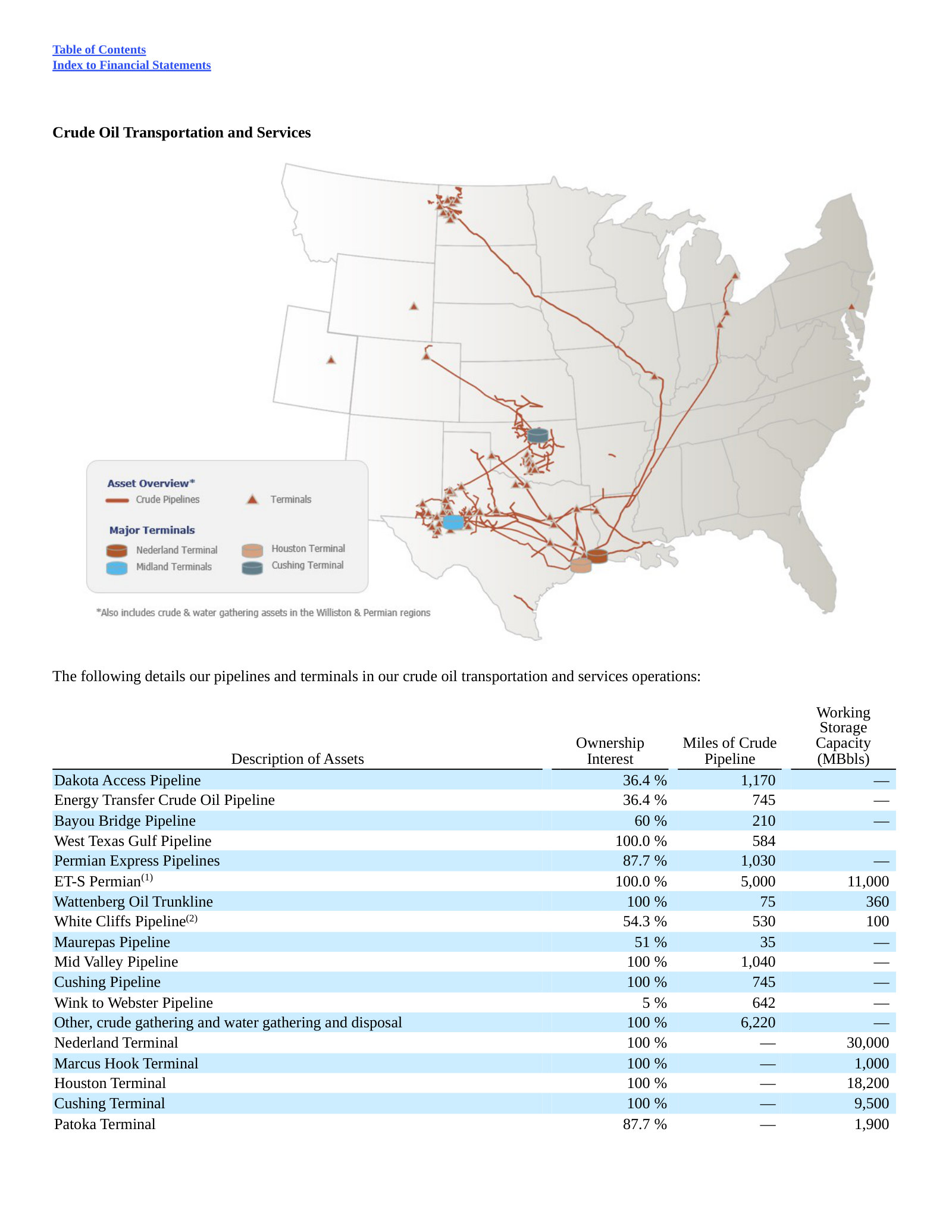
Energy Transfer's description, in the notes to its FY2025 financial statements, of the vehicle that now holds its Permian crude gathering — the structural analogue of PAA's own Permian gathering joint venture. Two disclosures are worth isolating. First, the perimeter: Energy Transfer's long-haul pipelines out of the Permian to Nederland, Houston and Cushing are explicitly carved out of ET-S Permian, so the joint venture is a gathering business and the long-haul economics stay with the parent. Second, the scale: more than 5,000 miles of crude oil and water gathering pipe and over 11 million barrels of storage. Those figures combine crude and produced-water gathering and are stated for the joint venture as a whole, of which Energy Transfer holds 67.5% and Sunoco 32.5%, so they are not an Energy Transfer net measure and cannot be compared like-for-like with a crude-only mileage figure.
Effective July 1, 2024, Energy Transfer and Sunoco LP formed ET-S Permian, a joint venture combining their respective crude oil and produced water gathering assets in the Permian Basin. […] Energy Transfer contributed its Permian crude oil and produced water gathering assets and operations to ET-S Permian. Sunoco LP contributed all of its Permian crude oil gathering assets and operations to ET-S Permian. Energy Transfer’s long-haul crude pipeline network that provides transportation of crude oil out of the Permian Basin to Nederland, Houston and Cushing is excluded from ET-S Permian.
ET-S Permian operates more than 5,000 miles of crude oil and water gathering pipelines with crude oil storage capacity in excess of 11 million barrels.
p. 348 · Read in context →
Prepared remarks from Energy Transfer's FY2025 third-quarter call describing two projects that would pull Canadian barrels into the Mid-Continent-to-Gulf corridor where PAA's Capline, Diamond and Patoka and St. James terminals sit. The Southern Illinois Connector is contracted — 100,000 barrels per day from an open season completed with Enbridge, connecting near Wood River to Energy Transfer's Patoka assets — and has taken FID. The larger item, roughly 250,000 barrels per day of Canadian crude through Dakota Access, had not: management says it expects to take FID by mid-2026, so it is a stated intention rather than a commitment. The framing is Energy Transfer's own — "much needed capacity for oil out of Canada" — and the commercial motive management gives is filling spare capacity on its existing Dakota Access and ETCOP lines rather than adding new pipe.
Thomas Long (Co-Chief Executive Officer, Energy Transfer): In September, Energy Transfer, along with Enbridge, completed a successful open season for the Southern Illinois Connector project, which resulted in 100,000 barrels per day of contracts for transportation of Canadian crude oil to Nederland from both Flanagan and Hardisty. This project will connect Enbridge's pipeline near Wood River to Energy Transfer's assets in Patoka, Illinois to support the delivery of Canadian crude oil to the U.S. refineries, further strengthening market connectivity and value for all our stakeholders. […] Separately, Energy Transfer is working with Enbridge to provide capacity for approximately 250,000 barrels per day of Canadian crude oil through our Dakota Access pipeline. This project would provide much needed capacity for oil out of Canada and would be a significant part of the steady volume throughput on Dakota Access for many years to come. We have taken FID on the Southern Illinois Connector project and expect to take FID on the other project by mid-2026. We are very excited about both projects, which would fill available and additional capacity on our Dakota Access and ETCOP pipelines, and we look forward to providing additional details in the future.
p. 3 · Read in context →
Enterprise Products Partners L.P. (EPD)
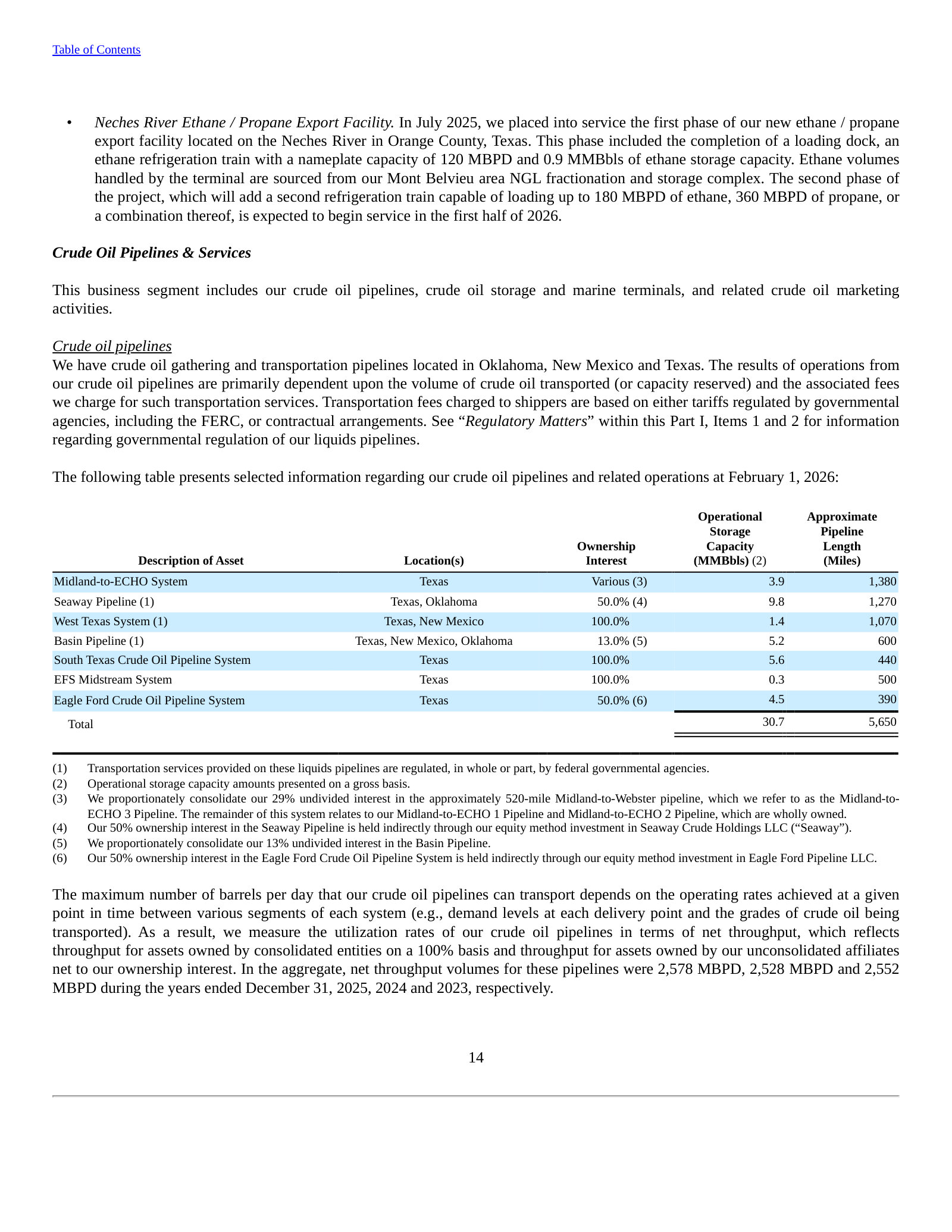
The competitor whose crude pipelines run the same Permian-to-Gulf-Coast lanes as PAA's and who, in places, owns the other end of the same asset: Enterprise holds a 13% undivided interest in the Basin Pipeline, in which PAA reports an 87% interest. Its Midland-to-ECHO system, West Texas System, Seaway and Eagle Ford lines total 5,650 miles and 30.7 MMBbls of storage, and its crude marketing arm competes with PAA's supply and logistics business for wellhead barrels. In January 2026 it converted part of the Seminole NGL pipeline to crude service, adding Permian-to-Gulf-Coast crude capacity of exactly the kind PAA cites as a source of tariff pressure. Exhibits cover the crude segment only; the NGL, LPG export and petrochemical discussion that dominates Enterprise is excluded.
An analyst putting the recontracting question directly to Enterprise about its main Permian long-haul crude system, and the answer. Management says the first Midland-to-ECHO contracts roll off in 2028, that roughly 20% of the book rolls that year, and that it has already been filling and blending-and-extending capacity in advance. No rate, term or renewal spread is disclosed, so the exhibit sizes the exposure without pricing it. It is the closest public marker in this set for a risk PAA names in its own filings — heightened competition for uncommitted barrels and contract renewals on long-haul Permian pipelines, and the downward pressure that puts on tariffs. The transcript contains minor transcription errors ("roll of in '28") that are reproduced as indexed.
Jean Ann Salisbury (Analyst, Bank of America) and Jay Bainey (Executive, Enterprise Products): And I guess as a follow-up, do most of the Midland to ECHO crude pipeline contracts roll off in 2028 to 2029? I know that there have been some discussion o blending and extending, so not sure if that should kind of be later at this point. […] Jean Ann, this is Jay Bainey. So for '28, we have our first contracts roll off. But over the really, the course of last year and the year prior, you know, we have done, not only new contracts to fill that space, but blend and extend. So it's roughly about 20% that roll of in '28, but we'll be working on that this year or next.
p. 5 · Read in context →
Enterprise's co-CEO positioning its storage hubs on the FY2025 fourth-quarter call. Three of the four hubs he names — Cushing, Midland and Houston — are hubs where PAA also operates large crude terminals, and the "14 million barrels per day of oil equivalent" and "50,000-mile" figures are company-wide across all products, not crude. The pointed part is the last sentence: "open access systems where our customers can trade freely without any concern of being held hostage" is a competitive claim aimed at midstream operators whose marketing arms trade alongside their terminals, which is a fair description of PAA's integrated supply-and-logistics model. Enterprise runs a large crude marketing business of its own, so the distinction being drawn is about terminal access terms rather than about abstaining from merchant activity; no access terms or tariffs are cited to support it.
Jim Teague (Co-Chief Executive Officer, Enterprise Products): In total, we move over 14 million barrels per day of oil equivalent to our 50,000-mile pipeline network. Additionally, Enterprise looks at its storage hubs as a critical part of its infrastructure to support its customers. Cushing, Midland, Houston, and Mont Belvieu. These are all open access systems where our customers can trade freely without any concern of being held hostage.
p. 1 · Read in context →
MPLX LP (MPLX)
A crude logistics competitor of comparable pipeline scale to PAA but built on the opposite commercial foundation. MPLX runs 14,853 miles of crude and products pipelines and 88 terminals, and is expanding crude gathering in the Permian and Bakken — both PAA basins — while roughly two-thirds owned by Marathon Petroleum, which underwrites it with minimum volume commitments. That contrast is the reason to read it: PAA competes for uncommitted third-party barrels, MPLX begins each year with a captive refiner behind its crude tariffs. Exhibits are confined to the Crude Oil and Products Logistics segment; the Natural Gas and NGL Services segment — Northwind, BANGL, Marcellus processing, Gulf Coast fractionation — is out of scope for a crude pure-play comparison.
MPLX's own definition and sizing of the segment that competes with Plains, from its FY2025 Form 10-K: 14,853 miles of wholly and jointly owned pipelines, refining logistics at 13 refineries, 88 terminals, one export terminal, storage caverns, tank farms, an inland marine business and fuels distribution. The mileage is a combined crude-and-products figure on a gross basis including jointly owned lines, so it is not comparable to a crude-only or net-interest count. The closing sentence is the one that distinguishes this business from PAA's: the assets are described as "integral to the success of MPC's operations," with third parties named second. "jointlyowned" appears as indexed.
The Crude Oil and Products Logistics segment includes the gathering, transportation, storage and distribution of crude oil, refined products, other hydrocarbon-based products and renewables. These assets consist of a network of 14,853 miles of wholly and jointlyowned pipelines and associated storage assets, refining logistics assets at 13 refineries, 88 terminals including rail and truck racks, one export terminal, storage caverns, tank farm assets, an inland marine business and a fuels distribution business. For information related to our Crude Oil and Products Logistics assets, please see Item 2. Properties – Crude Oil and Products Logistics. Our Crude Oil and Products Logistics assets are integral to the success of MPC’s operations. We continue to evaluate projects and opportunities that will further enhance our existing operations and provide valuable services to MPC and third parties.
p. 15 · Read in context →
The sponsor relationship spelled out in MPLX's FY2025 Form 10-K — MPC held roughly 64% of MPLX's common units at year-end and takes service under long-term fee-based agreements that "include minimum committed volumes." The same page's table sets MPC's minimum commitment on crude pipelines at 1,933 mbpd under agreements with four- to ten-year initial terms. For a Plains reader the point is structural rather than promotional: a competitor of similar pipeline scale carries a contracted floor under its crude volumes that PAA, whose largest customer is a third party, does not. MPLX's belief that MPC "will promote and support" its strategies is the partnership's own characterisation, not a contractual right. The passage also names the Permian-to-Gulf-Coast value chain as the organising idea behind its recent acquisitions.
One of our competitive strengths is our strategic relationship with MPC, which operates one of the largest refining systems in the United States in terms of refining capacity. MPC owns and operates 13 refineries in the Gulf Coast, Mid-Continent and West Coast regions of the United States and distributes refined products, including renewable diesel, through transportation, storage, distribution and marketing services provided primarily by MPLX.
MPC retains a significant interest in us through its non-economic ownership of our general partner and held approximately 64 percent of the outstanding common units of MPLX as of December 31, 2025. Given MPC’s significant interest in us, we believe MPC will promote and support the successful execution of our business strategies. We have implemented and continue to pursue growth and integration opportunities along the existing product-based value chains that benefit both MPC and MPLX, demonstrated by the continued expansion of the Permian to Gulf Coast integrated value chain, which includes the recently completed Northwind Midstream Acquisition and BANGL Acquisition. […] Our Crude Oil and Products Logistics assets are strategically located within, and integral to, MPC’s operations. We have entered into multiple transportation, terminal and storage services agreements with MPC. Under these long-term, fee-based agreements, we provide transportation, terminal and storage services to MPC and most of these agreements include minimum committed volumes from MPC.
p. 16 · Read in context →
MPLX's stated crude-segment growth agenda, from prepared remarks on the FY2025 second-quarter call. Two of the items land directly on PAA: expanding crude gathering in the Permian and the Bakken, where PAA operates its Permian joint venture and its Rockies and Bakken systems, and "developing new market outlets" for those barrels. No capital figure, mileage or volume target is attached to the crude line here — MPLX has said separately that over 90% of its growth capital goes to the natural gas and NGL segment — so this reads as a statement of direction rather than a sized programme.
Maryann T. Mannen (President and CEO, MPLX): In our crude oil and products logistics segment, we are expanding crude gathering infrastructure in the Permian and Bakken basins, advancing butane blending initiatives at our product terminals, developing new market outlets, driving organic volume growth through our integrated network and pursuing other high-return projects aimed at maximizing the utilization of our assets.
p. 1 · Read in context →
Western Midstream Partners, LP (WES)
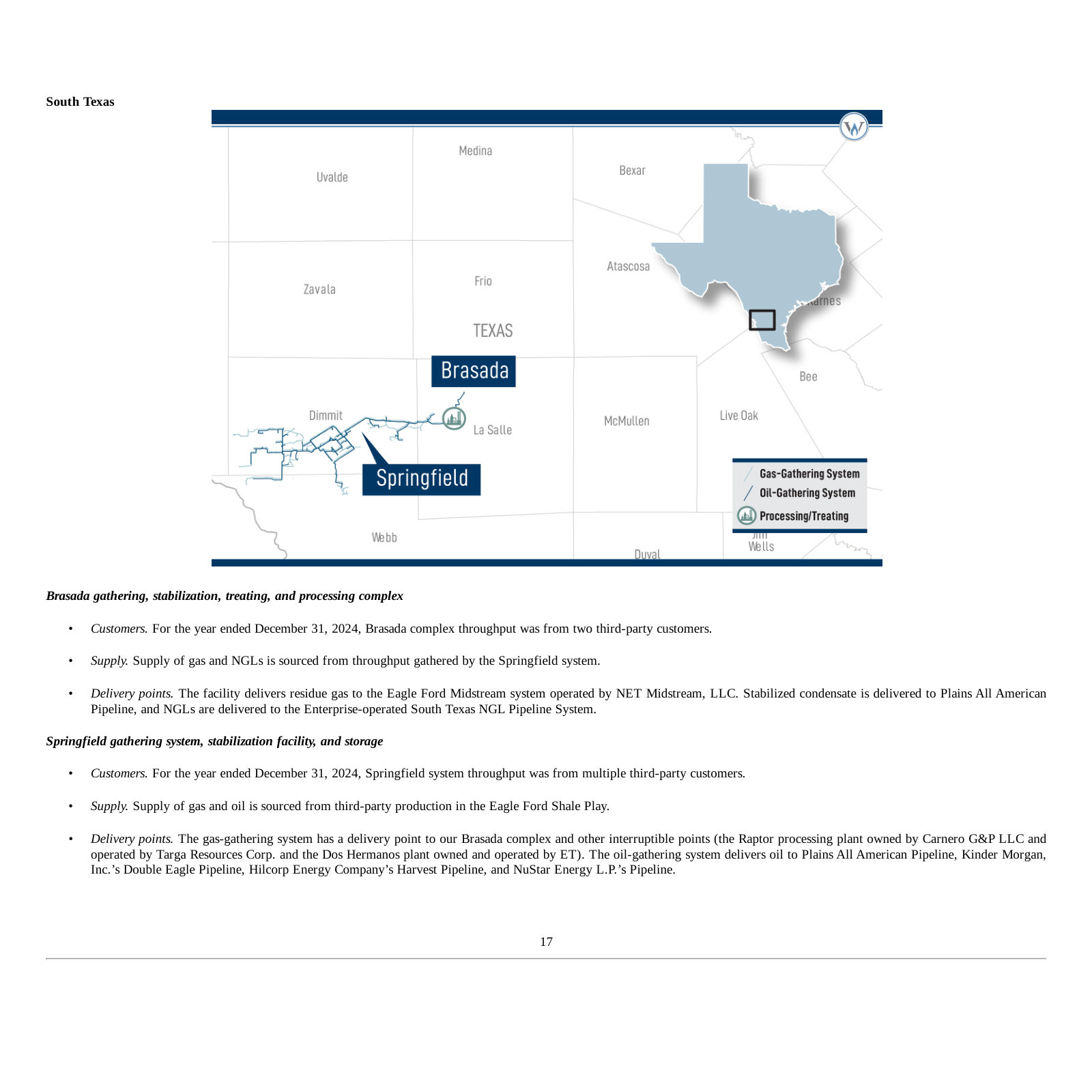
The peer that sits immediately upstream of Plains rather than across from it. Western Midstream gathers crude in the Delaware and DJ Basins and South Texas and hands it to long-haul carriers — PAA among them, by name, in its own Form 10-K — while stating publicly that it does not compete in long-haul pipelines at all. That makes it two things at once: a source of barrels for PAA's lines and a rival for the wellhead dedications that determine whose lines those barrels reach. It is also a former partner in assets PAA now consolidates, having sold its 15% interest in Cactus II in 2022. Exhibits are limited to the crude oil gathering business; the natural gas processing and produced-water discussion that drives most of WES's earnings is out of scope.
Western Midstream's CEO answering a direct question about midstream consolidation and whether WES needs to be bigger, on the FY2025 fourth-quarter call. The answer draws an explicit boundary: "Where we are limited, we don't compete. We are a gathering and processing company, so we aren't involved in long-haul pipeline activities." That is a competitor voluntarily ceding the segment PAA occupies and explains why WES's own filings list PAA as an outlet rather than a rival. Two claims are the company's own and unaudited: that it is "ten times the size of our next significant competitor" in produced water, which depends entirely on how that market is defined and is not sourced here, and that scale matters "across all the markets we operate in." The project sizes he gives — $200 million to $300 million — describe gathering systems, compression and processing plants, not pipelines.
Jeremy Tonet (Analyst, JPMorgan) and Oscar Brown (Chief Executive Officer, Western Midstream): I'm curious about your thoughts on how WES compares, especially since many competitors have grown significantly. Would it be beneficial for WES to expand further in order to compete more effectively with these larger entities, or do you believe that your current size is sufficient? […] I believe we are at a good size, but we can always grow. With the consolidation among our customers and within the midstream sector, scale will continue to be important. One reason we will remain a leader in the water business is that we are ten times the size of our next significant competitor in this sector, which allows us to tackle projects that would challenge their capabilities. This principle applies across all the markets we operate in. Scale is certainly important, but we don't intend to get larger for the sake of it; we will continue to execute our growth strategy. Where we are limited, we don't compete. We are a gathering and processing company, so we aren't involved in long-haul pipeline activities. The types of projects that fit our expertise—like gathering systems, new compression facilities, gas processing plants, and potentially expanding into CO2 solutions— are all manageable at our current size.
p. 9 · Read in context →
Genesis Energy, L.P. (GEL)
The smallest peer here and the one that competes with Plains on a different axis: supply source and transport mode rather than basin. Genesis moves deepwater Gulf crude to onshore Texas and Louisiana refining centres on the CHOPS and Poseidon systems, then handles, blends and stores it at its own onshore terminals — the Gulf Coast market PAA's St. James, Patoka and Gulf Coast terminals serve — and separately runs a Jones Act marine fleet, which is one of the alternative transport modes PAA names as competition in its own filings. It also carries PAA in its executive compensation peer group. Exhibits are confined to offshore crude pipeline transportation and its onshore extension; the soda ash and sulfur services businesses, which have nothing to do with PAA, are excluded.
Genesis sizing its own market and its position in it, in the FY2025 Form 10-K. The market claim is that the Gulf of America accounted for approximately 14% of U.S. crude oil production in 2025 — a supply pool that reaches Gulf Coast refineries and export docks in competition with the Permian barrels PAA moves. The position claim is 1,536 miles of operating offshore crude pipe with roughly 2,094 MBbls per day of aggregate design capacity, and 64% interests in CHOPS and Poseidon, described as "two of the largest crude oil pipelines (in terms of both length and design capacity) located in the Gulf of America." Design capacity is a nameplate figure, not throughput, and the mileage and capacity are stated for systems in which Genesis holds partial interests, so neither is a net-to-Genesis measure.
The Gulf of America is one of the most active drilling and development regions in the U.S. representing approximately 14% of the crude oil production in the U.S. during 2025. […] Our interests in offshore crude oil pipeline systems that are currently operating (a number of which pipeline systems are substantial and/or strategically located) include approximately 1,536 miles of pipe with an aggregate design capacity of approximately 2,094 MMbls/day. For example, we own a 64% interest in the CHOPS Pipeline and a 64% interest in the Poseidon Pipeline, which are two of the largest crude oil pipelines (in terms of both length and design capacity) located in the Gulf of America.
p. 13 · Read in context →
Genesis management's reserve-replacement arithmetic for its offshore system and its claim to a unique position in the region, from the FY2025 third-quarter call. On the preceding page of the same call, management put expected throughput at roughly 750,000 barrels per day once Shenandoah and Salamanca ramp, or about 275 million barrels a year; here it argues that at an assumed 25 million barrels of ultimate recovery per deepwater well, about eleven new wells a year tied back to connected platforms would hold that throughput flat with no further capital. Both inputs are management's assumptions, the recovery figure is described as conservative but is not sourced, and the drilling is done by third-party producers, not Genesis. The positioning claim — "the only truly independent third-party provider of crude oil pipeline logistics in the region" — turns on reading "independent" as unaffiliated with a producer or refiner; several other operators own offshore Gulf crude pipelines.
Grant Sims (Chief Executive Officer, Genesis Energy): At a conservative average economic ultimate recovery of 25 million barrels of oil per deepwater well, we need to have the producing community drill, complete and tie back to FPUs currently connected to our infrastructure, only 11 or so wells per year to, in essence, fully replace the reserves produced and transported through our pipelines in any one year. This, in turn, simply extends or annuitizes our ability to produce these anticipated 2026 type run rate financial results from our offshore segment for many years, if not decades in the future without having to spend any money. […] We continue to engage in robust commercial discussions with producers across the Central Gulf of America, and we believe Genesis is uniquely positioned as the only truly independent third-party provider of crude oil pipeline logistics in the region, setting the stage for continued growth in decades and decades of opportunities out of this world-class basin.
p. 3 · Read in context →
More peer documents
ONEOK — Q4 FY2025 earnings call — Q4 FY2025 · 14 pages · Page 4 states that ONEOK expects increased throughput into its long-haul crude pipelines from its own gathering systems as interconnectivity expands, with further synergy projects landing in 2026 and 2027 — the multi-year version of the barrel-steering exhibit. · Open →
Western Midstream — FY2025 Form 10-K — FY2025 · 221 pages · Page 31 describes White Cliffs, in which WES holds 10% and PAA also holds an interest, delivering Rockies crude from Platteville to Cushing; pages 74 and 129 detail the 2024 exits from Saddlehorn and Whitethorn, two more assets PAA is connected to. · Open →
Enterprise Products Partners — Q2 FY2025 earnings call — Q2 FY2025 · 9 pages · Page 1 is Jim Teague on export-market overbuild — spot terminal fees down about 60% year on year and a legacy double-digit-fee contract recontracted at market — with a stated intention to "aggressively defend our position" using brownfield economics. The clearest peer account of what recontracting into an overbuilt market costs. · Open →
MPLX — Q1 FY2026 earnings call — Q1 FY2026 · 6 pages · Page 3 covers the Gulf Coast crude picture from a refinery-connected operator: Mount Airy running harder next to Garyville, Venezuelan barrels arriving through LOOP, and imports and exports both rising across that asset base. · Open →